
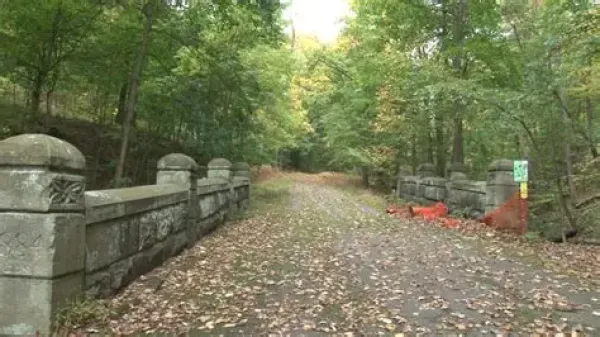
The city of Steubenville in Jefferson County has received bids from two drilling companies to frack its historic Beatty Park, a 177-acre park. The community and park hail from the late 1700s, when Fort Steuben was founded to protect surveyors measuring the land from Native American tribes who resisted the new government’s expansion into the Northwest Territory. The fort and later, city, were named in honor of Baron Friedrich Wilhelm von Steuben, a Prussian army officer who reformed the Continental Arm during the American Revolutionary War. (WTRF Photo)
Recently Save Ohio Parks was contacted regarding a plan by the mayor and city council of Steubenville to lease 19 parcels totaling about 157 acres, including 99 acres of historic Beatty Park, for fracking. In looking into this proposal, we found:
- The city passed an ordinance authorizing leasing public lands for fracking in October 2025 after being approached by several oil and gas companies..
- The city tried to bid out four parcels including 99 acres of Beatty Park and several acres of Jim Wood Park in December 2025, but got no bids.
- In April, the city tried again with 19 parcels and got two bids -– one from Ascent Resources - Utica for $1.1 million, and one from Pike Petroleum for $249,000.
- The city held a public hearing on June 2. Dozens of people showed up and expressed concerns.
- The city was supposed to vote on whether to accept one of these bids on June 11 but delayed the vote to July 14.
In light of this upcoming vote, Save Ohio Parks has numerous questions about the city of Steubenville’s plan to lease Beatty and Jim Wood parks for fracking.
- City leaders say there will be “no surface use”- - meaning the fracking pads will be located outside the city parks. But how far outside? The air pollution, noise, and lights from fracking travel for miles and do not stop at park boundaries. Even if fracking is happening outside the parks, it will still greatly affect the parks.
- Each frack well is typically allowed to take 100,000 gallons of fresh water per day from nearby streams, rivers, and lakes, for a total of 40 million to 60 million gallons per well. Where will the water to frack Beatty and Jim Wood parks come from? Has any hydrologist examined how that would affect water flow within the parks?
- All the water, sand, and chemicals used in fracking operations must be brought in truckload by truckload. Then the resulting frack waste must be carried back out truckload by truckload. This amounts to thousands of truck trips each way per well. Can Steubenville’s roads handle this kind of consistent and heavy truck traffic?
- Fracking injects water and sand laced with toxic chemicals at high pressure into wells to free oil and gas. When this mixture comes back up, it brings radioactive elements Radium 226 and Radium 228. These are bone-seeking and cancer causing. How will Steubenville oversee disposal of tens of millions of gallons of toxic and radioactive frack waste per well fracking these 19 parcels?
- The only households notified of the plan by letter were those within 500 feet. However, in leases to frack Salt Fork State Park, the Ohio Department of Natural Resources required frack pads be at least 1000 feet from the park border. Why did Steubenville notify people only within 500 feet and not 1000 feet or one mile?
- The areas around Beatty Park and Jim Wood parks are highly residential. Many are likely to have fracking occurring under their homes whether they consent to it or not. Are homeowners aware they can be forced into fracking? Is Steubenville city government prepared for homeowners who do not want their land to be fracked?
- Union Cemetery - Beatty Park is on the National Register of Historic Places, which is maintained by the National Park Service. That means there is a federal interest in Beatty Park. On the state level, whenever there is a federal interest in land nominated for fracking, that land is required to go through the National Environmental Policy Act process. This happened with Zepernick and Leesville wildlife areas. Will Steubenville allow Beatty Park to go through a NEPA process
- Why were the citizens of Steubenville, who own and have used Beatty Park for decades, not given an opportunity to comment on the proposal to frack this historic park before oil and gas bids were solicited? On the state level, Ohio citizens are informed of nominations to frack public land and given 45 days to comment before a decision is made to seek bids. Decision makers are required by law to consider comments and objections from Ohio citizens, along with criteria such as environmental impact, geological impact, compatible use, and effects on visitors. Did the city of Steubenville consider any such criteria before soliciting bids?
- On the state level, any payments from oil and gas companies from fracking public land go into a special State Land Royalty Fund, where money is allocated for purposes designated by the state legislature. Will the city of Steubenville deposit any revenue from fracking Beatty and Jim Wood parks and the other parcels into a special fund so that how this money is used can be transparently tracked? Or will this revenue go into the general city budget where it is mixed into the broader municipal funds, making it impossible to track how this money is used?
- The posted lease document contains contradictory information regarding injection wells that take tens of millions of gallons of toxic, radioactive fracking waste. Page 10 grants the lessee the right to drill wells for the disposal or injection of fracking waste on the leased property. But page 13 says the lessee is not granted any right to use the leasehold for construction and operation of disposal or injection wells. So which is it? Will the oil and gas company fracking Beatty Park be able to put an injection well for toxic and radioactive fracking waste wherever they want, or not? Is the city of Steubenville prepared to oversee and regulate such injection wells?
- Research by Save Ohio Parks and FracTracker finds the oil and gas industry in Ohio experienced almost 2000 accidents and incidents from 2015 to 2023 – an accident or incident every 1.5 days. Is Steubenville prepared to deal with leaks, spills, gas releases, fires, explosions, and truck rollovers that regularly come with fracking?
- In soliciting bids to frack public land, did the city of Steubenville require oil and gas companies to include a certificate of insurance? If so, did the city require the insurance be up to date, and require liability insurance of at least $5 million, as is required by Ohio state law? Will the city make these insurance certificates public, as the state does for companies selected to frack public lands?
Given that the state of Ohio is charging ahead with plans to frack its own state parks and wildlife areas – despite thousands of public comments that run 98% to 100% opposed – it is no surprise that some cities now want a piece of the oil and gas pie. But that doesn’t make selling out our children’s future right. Parks were set aside in the public trust and meant to be protected – not subjected to industrial oil and gas extraction.
Save Ohio Parks finds it alarming that the city of Steubenville would proceed so quickly to frack its most treasured and historic park with so many questions unanswered. In months of city council meeting minutes, one would be hard pressed to find any city leader express any concern about the environment, the park, or what their own citizens want.
We urge Steubenville city leaders to step back from this ill-thought-out plan to frack Beatty and Jim Wood parks, and instead find other sources of revenue.